Ditapis dengan

Low Cost, Low Technology Compliance Monitoring : Assessment of Permit Complia…
The objective of this publication is to provide practical information about using low cost and low technology approaches that are useful for monitoring compliance with permit conditions associated with ocean disposal of waste materials or other matter. The primary audiences for this guidance are countries that are in the early stages of developing waste assessment and monitoring actions in conc…
- Edisi
- Edition 2017
- ISBN/ISSN
- 978-92-801-1663-2
- Deskripsi Fisik
- vii, 48 hal : ill ..; 21 x 29,5 cm
- Judul Seri
- -
- No. Panggil
- 344.046 343 IMO l

Low Cost, Low Technology Field Monitoring : Assessment of the Effects of Disp…
The objective of this publication is to provide practical information about using low cost and low technology tools that are useful for monitoring of possible environmental impacts associated with disposal at sea of either dredged material or inert, inorganic geological materials. The primary audiences for this guidance are countries that are in the early stages of developing waste assessment …
- Edisi
- Edition 2016
- ISBN/ISSN
- 978-92-801-1656-4
- Deskripsi Fisik
- xv, 110 hal ; ill..; 20,5 x 29,5 cm
- Judul Seri
- -
- No. Panggil
- 344.046 343 IMO l

Hong Kong Convention : Hong Kong International Convention for the safe and En…
This publication presents: the Hong Kong International Convention for the Safe and Environmentally Sound Recycling of Ships, 2009; six resolutions adopted at the International Conference on the Safe and Environmentally Sound Recycling of Ships held under the auspices of the International Maritime Organization in Hong Kong, China, from 11 to 15 May 2009; six sets of guidelines for the unifo…
- Edisi
- Edition 2013
- ISBN/ISSN
- 978-92-801-1510-9
- Deskripsi Fisik
- viii, 183 hal : ill ..; 21 x 30 cm
- Judul Seri
- -
- No. Panggil
- 343.096 8 IMO h

Operational Guidelines on Sunken and Submerged Oil Assessment and Removal Tec…
The aim of the Guidelines is to provide practical guidance for assessing and responding to incidents involving sunken oil. Their scope is confined to sunken and submerged oil and does not include oil on sunken wrecks. The Guidelines also include references to other information sources.
- Edisi
- Edition 2016
- ISBN/ISSN
- 978-92-801-1589-5
- Deskripsi Fisik
- 84 hal : ill..; 21 x 29,5 cm
- Judul Seri
- -
- No. Panggil
- 341.762 53 IMO o

2009 MODU CODE = Code for the Construction and Equipment of Mobile Offshore D…
The 2009 MODU Code present a major revision of the 1989 MODU Code. It contains, amongst others : * Updated provisions for helicopter facilities, * Clarification of Differing jurisdiction and control mechanisms of port and coastal States, * Changes to the provisions for casualty investigations, * New Provisions for means of access and safe access to spaces * Provisions for anti-fouling s…
- Edisi
- Edition 2010
- ISBN/ISSN
- 978-92-801-1525-3
- Deskripsi Fisik
- ix, 192 hal ..; 14,5 x 21 cm
- Judul Seri
- -
- No. Panggil
- 621.95 IMO m
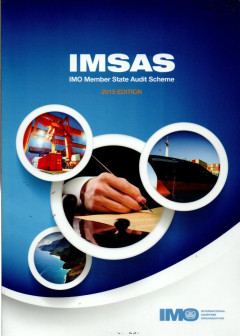
IMSAS = IMO Member State Audit Scheme, 2015 edition
This publication contains all relevant resolutions adopted by the International Maritime Organization (IMO) in the process of the institutionalization of the IMO Member State Audit Scheme (IMSAS), as well as other documents developed to support its effective implementation. It includes: Framework and Procedures for IMSAS - IMO Instruments Implementation Code (III Code) 2013 non-exhaustive…
- Edisi
- Edition 2015
- ISBN/ISSN
- 978-92-801-1591-8
- Deskripsi Fisik
- vi, 201 hal.; 21 x 29,5 cm
- Judul Seri
- -
- No. Panggil
- 623.88 IMO i

Guidelines on International Offers of Assistance in Response to a: MArine Oil…
Countries facing a major pollution emergency may require external resources to augment national response capacity for large, complex or significant oil spill incidents. In such cases, the Requesting Country may wish to issue a request for international assistance. This can be done bilaterally, multilaterally, or possibly through a regional mechanism, where these exist. Correspondingly, major oi…
- Edisi
- Edition 2016
- ISBN/ISSN
- 978-92-801-1651-9
- Deskripsi Fisik
- viii, 70 hal..; 21 x 29,5 cm
- Judul Seri
- -
- No. Panggil
- 104.479 4 IMO g

Seafarers' Hours of Work and Hours of Rest : IMO/ILO Guidelines for the Devel…
Developed by a joint working group of the International Labour Organization (ILO) and IMO, these guidelines are designed to help Administrations, shipowners and seafarers meet their obligations under ILO Convention No. 180 (Seafarers’ Hours of Work and the Manning of Ships Convention) and IMO’s STCW Convention, 1978, as amended in 1995. They provide a standardized table showing shipboard w…
- Edisi
- -
- ISBN/ISSN
- 978-92-801-6095-6
- Deskripsi Fisik
- v, 22 hlm.; 14 x 21 cm
- Judul Seri
- -
- No. Panggil
- 623.88 IMO s

London Convention and Protocol : Guidance for the Development of Action Lists…
- Edisi
- Edition 2009
- ISBN/ISSN
- 978-92-801-1504-8
- Deskripsi Fisik
- iii, 178 hal ; ill..; 15 x 21,5 cm
- Judul Seri
- -
- No. Panggil
- 368.728 4 IMO l
- Edisi
- Edition 2009
- ISBN/ISSN
- 978-92-801-1504-8
- Deskripsi Fisik
- iii, 178 hal ; ill..; 15 x 21,5 cm
- Judul Seri
- -
- No. Panggil
- 368.728 4 IMO l

Goal-Based Ship Contruction Standards : For Bulk Carriers and Oil Tankers and…
The notion of "goal-based ship contruction standards" was introduced in IMO at the eighty-ninth session of the council in November 2002 through a proposal by the Bahamas and Greece (C 89/12/1), suggesting that IMO should play a large role in determining the standards to which new ships are built, traditionally the responsibility of classification societies and shipyards.
- Edisi
- -
- ISBN/ISSN
- 978-92-801-1563-5
- Deskripsi Fisik
- vi, 59 hlm ; 21 x 29,5 cm
- Judul Seri
- -
- No. Panggil
- 623.81 IMO g
 Karya Umum
  Filsafat
  Agama
Agama  Ilmu-ilmu Sosial
  Bahasa
  Ilmu-ilmu Murni
  Ilmu-ilmu Terapan
  Kesenian, Hiburan, dan Olahraga
  Kesusastraan
  Geografi dan Sejarah