Ditapis dengan
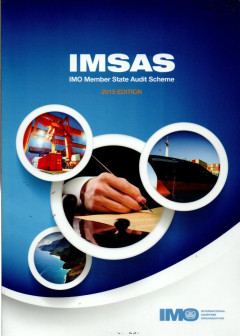
IMSAS = IMO Member State Audit Scheme, 2015 edition
This publication contains all relevant resolutions adopted by the International Maritime Organization (IMO) in the process of the institutionalization of the IMO Member State Audit Scheme (IMSAS), as well as other documents developed to support its effective implementation. It includes: Framework and Procedures for IMSAS - IMO Instruments Implementation Code (III Code) 2013 non-exhaustive…
- Edisi
- Edition 2015
- ISBN/ISSN
- 978-92-801-1591-8
- Deskripsi Fisik
- vi, 201 hal.; 21 x 29,5 cm
- Judul Seri
- -
- No. Panggil
- 623.88 IMO i

Guidelines on International Offers of Assistance in Response to a: MArine Oil…
Countries facing a major pollution emergency may require external resources to augment national response capacity for large, complex or significant oil spill incidents. In such cases, the Requesting Country may wish to issue a request for international assistance. This can be done bilaterally, multilaterally, or possibly through a regional mechanism, where these exist. Correspondingly, major oi…
- Edisi
- Edition 2016
- ISBN/ISSN
- 978-92-801-1651-9
- Deskripsi Fisik
- viii, 70 hal..; 21 x 29,5 cm
- Judul Seri
- -
- No. Panggil
- 104.479 4 IMO g

Seafarers' Hours of Work and Hours of Rest : IMO/ILO Guidelines for the Devel…
Developed by a joint working group of the International Labour Organization (ILO) and IMO, these guidelines are designed to help Administrations, shipowners and seafarers meet their obligations under ILO Convention No. 180 (Seafarers’ Hours of Work and the Manning of Ships Convention) and IMO’s STCW Convention, 1978, as amended in 1995. They provide a standardized table showing shipboard w…
- Edisi
- -
- ISBN/ISSN
- 978-92-801-6095-6
- Deskripsi Fisik
- v, 22 hlm.; 14 x 21 cm
- Judul Seri
- -
- No. Panggil
- 623.88 IMO s

London Convention and Protocol : Guidance for the Development of Action Lists…
- Edisi
- Edition 2009
- ISBN/ISSN
- 978-92-801-1504-8
- Deskripsi Fisik
- iii, 178 hal ; ill..; 15 x 21,5 cm
- Judul Seri
- -
- No. Panggil
- 368.728 4 IMO l
- Edisi
- Edition 2009
- ISBN/ISSN
- 978-92-801-1504-8
- Deskripsi Fisik
- iii, 178 hal ; ill..; 15 x 21,5 cm
- Judul Seri
- -
- No. Panggil
- 368.728 4 IMO l

Goal-Based Ship Contruction Standards : For Bulk Carriers and Oil Tankers and…
The notion of "goal-based ship contruction standards" was introduced in IMO at the eighty-ninth session of the council in November 2002 through a proposal by the Bahamas and Greece (C 89/12/1), suggesting that IMO should play a large role in determining the standards to which new ships are built, traditionally the responsibility of classification societies and shipyards.
- Edisi
- -
- ISBN/ISSN
- 978-92-801-1563-5
- Deskripsi Fisik
- vi, 59 hlm ; 21 x 29,5 cm
- Judul Seri
- -
- No. Panggil
- 623.81 IMO g

OSV CODE : Code of Safe Practice for the Carriage of Cargoes and Persons by O…
The purpose of this Code was adopted by resolution A.863(20), is to provide, for both operator and contractor, an international Stardard to avoid or reduce to a minimum the hazzards which affect offshore supply vessels in their daily operation of carrying cargoes and persons from and between offshore installations. This standard should be considered when implementing a safety management system …
- Edisi
- Edition 2000
- ISBN/ISSN
- 978-92-801-6086-4
- Deskripsi Fisik
- v, 18 hal ..; 14,5 x 21 cm
- Judul Seri
- -
- No. Panggil
- 623.888 IMO o

International Convention for the : Prevention of Pollution of the Sea by Oil,…
This Convention was the first multilateral instrument to be concluded with the prime objective of protecting the environment. It is concerned with the agreement between the Governments involved to prevent pollution of the sea by oil discharged from ships. The text published is as amended in 1962 and 1969
- Edisi
- -
- ISBN/ISSN
- 978-92-801-1118-7
- Deskripsi Fisik
- v, 19 hal,; 14 x 20 cm
- Judul Seri
- -
- No. Panggil
- 341.762 3 IMO i

Guidelines for the Provisional Assessment of Liquids Transported in Bulk
These Guidelines were approved in conjunction with the extension of the unified interpretation of regulation 3(4) of Annex II of MARPOL 73/78, which made it possible for Administrations to authorize manufacturers to carry out provisional assessments on IMO's behalf. The Guidelines also provide step-by-step procedures for ascertaining the carriage requirements of all liquids offered for bulk car…
- Edisi
- -
- ISBN/ISSN
- 978-92-801-1439-3
- Deskripsi Fisik
- vi, 44 hlm.; 15 x 21 cm
- Judul Seri
- -
- No. Panggil
- 343.093 IMO g

Manual on : Chemical Pollution : Section 3 - Legal and Administrative Aspects…
This publication aims to assist Goverments in the implementation of the Protocol on Preparedness, Response and Co-operation to Pollution incidents by Hazardous and Noxious Substances, 2000 (OPRC-HNS Protocol 2000), describing the obligations imposed under the protocol and the means of meeting tese obligations. The manual aim to provide the reader, in particular on-scene commanders, response pe…
- Edisi
- Edition 2015
- ISBN/ISSN
- 978-92-801-1614-4
- Deskripsi Fisik
- x, 50 hal.; 15 x 21 cm
- Judul Seri
- Section 3 - Legal and Administrative Aspects of HNS Incidents
- No. Panggil
- 363.739 4 IMO m

Manual on Oil Pollution Section VI : IMO Guidelines for Sampling and Identifi…
The IMO Guidelines from Sampling and Identification of Oil Spills are intended to provide guidance to Governments, including those of developing countries, on the techniques, equipment and strategies for sampling oil to identify unknown sources of spilled oil. Although references are given for the laboratory methods required for analysis, the emphasis in this text is on the details of the field…
- Edisi
- -
- ISBN/ISSN
- 978-92-801-1451-5
- Deskripsi Fisik
- v, 44 hlm, ill.; 14 x 21 cm
- Judul Seri
- -
- No. Panggil
- 628.168 33 IMO m
 Karya Umum
  Filsafat
  Agama
Agama  Ilmu-ilmu Sosial
  Bahasa
  Ilmu-ilmu Murni
  Ilmu-ilmu Terapan
  Kesenian, Hiburan, dan Olahraga
  Kesusastraan
  Geografi dan Sejarah